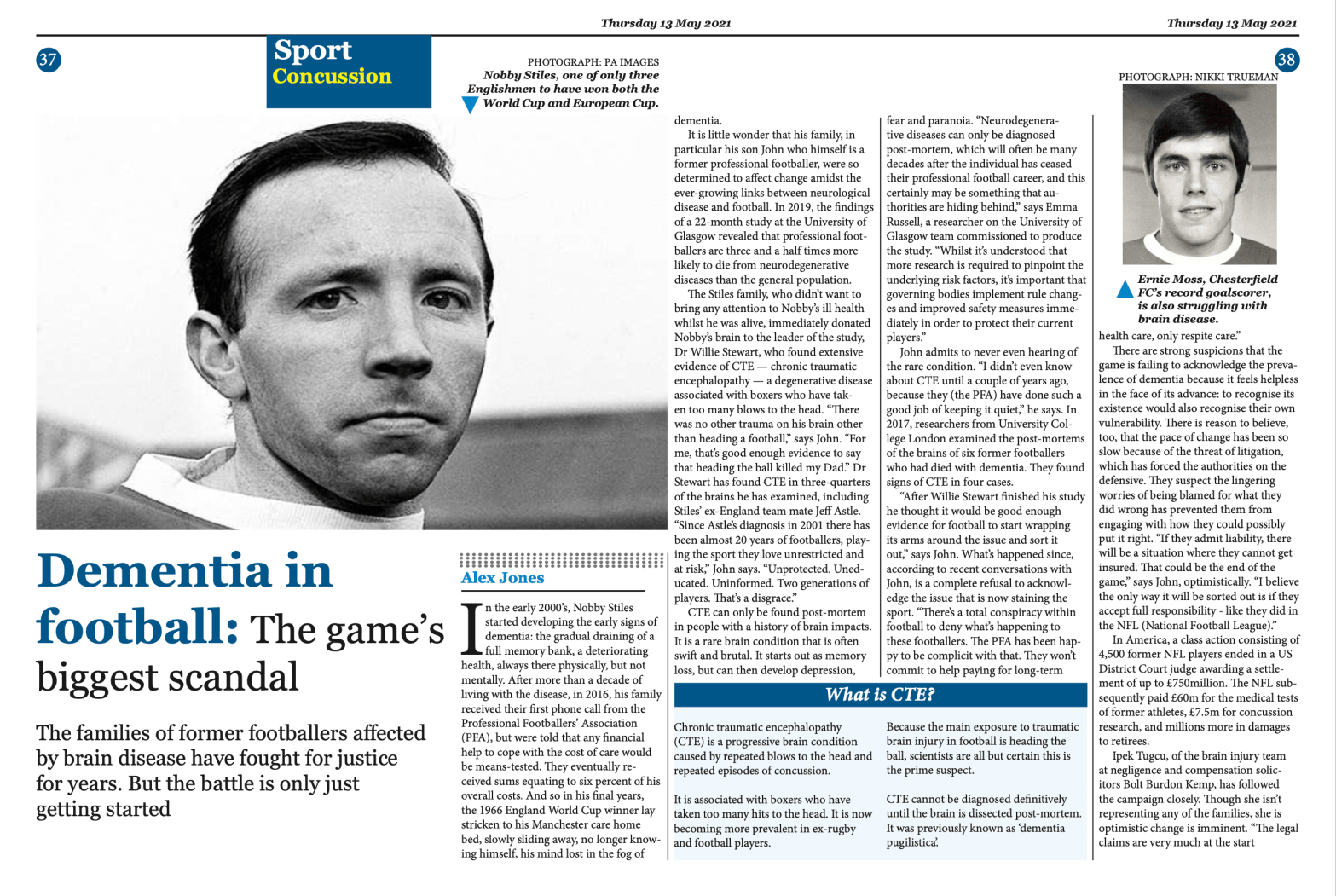
My final project at university, a 4,000 word print portfolio on Dementia in Football: The game’s biggest scandal. Below are screenshots of my Adobe PDF.
If you would like me to email a copy, please email alexjones8799@gmail.com Thanks!
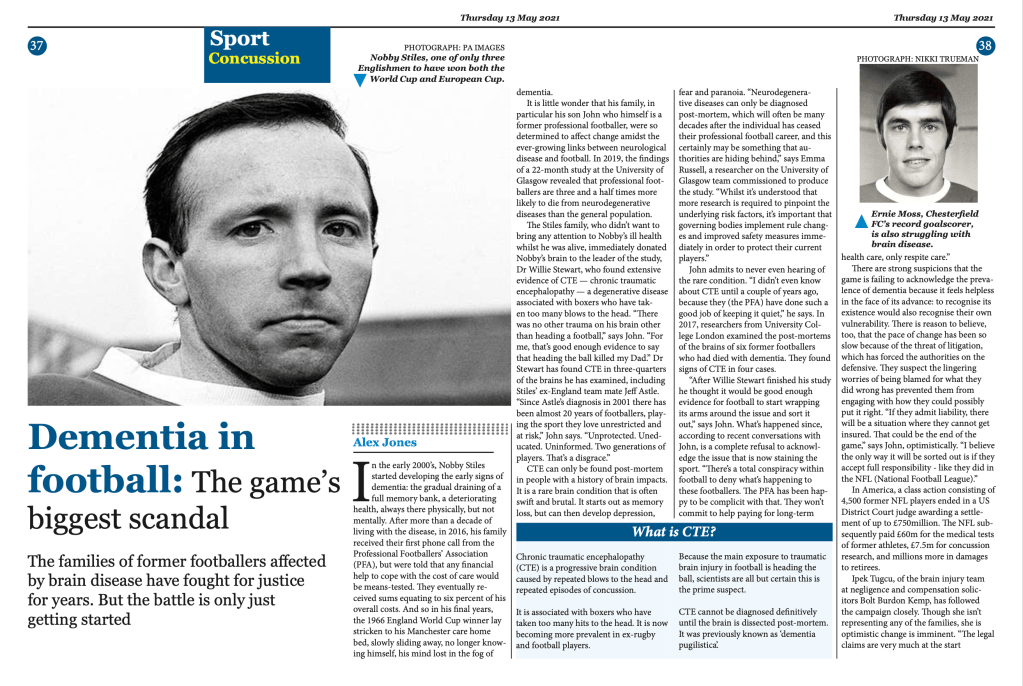
In the early 2000’s, Nobby Stiles started developing the early signs of dementia: the gradual draining of a full memory bank, a deteriorating health, always there physically, but not mentally. After more than a decade of living with the disease, in 2016, his family received their first phone call from the Professional Footballers’ Association (PFA), but were told that any financial help to cope with the cost of care would be means-tested. They eventually received sums equating to six percent of his overall costs. And so in his final years, the 1966 England World Cup winner lay stricken to his Manchester care home bed, slowly sliding away, no longer knowing himself, his mind lost in the fog of dementia.
It is little wonder that his family, in particular his son John who himself is a former professional footballer, were so determined to affect change amidst the ever-growing links between neurological disease and football. In 2019, the findings of a 22-month study at the University of Glasgow revealed that professional footballers are three and a half times more likely to die from neurodegenerative diseases than the general population.
The Stiles family, who didn’t want to bring any attention to Nobby’s ill health whilst he was alive, immediately donated Nobby’s brain to the leader of the study, Dr Willie Stewart, who found extensive evidence of CTE — chronic traumatic encephalopathy — a degenerative disease associated with boxers who have taken too many blows to the head. “There was no other trauma on his brain other than heading a football,” says John. “For me, that’s good enough evidence to say that heading the ball killed my Dad.” Dr Stewart has found CTE in three-quarters of the brains he has examined, including Stiles’ ex-England team mate Jeff Astle. “Since Astle’s diagnosis in 2001 there has been almost 20 years of footballers, playing the sport they love unrestricted and at risk,” John says. “Unprotected. Uneducated. Uninformed. Two generations of players. That’s a disgrace.”
CTE can only be found post-mortem in people with a history of brain impacts. It is a rare brain condition that is often swift and brutal. It starts out as memory loss, but can then develop depression, fear and paranoia. “Neurodegenerative diseases can only be diagnosed post-mortem, which will often be many decades after the individual has ceased their professional football career, and this certainly may be something that authorities are hiding behind,” says Emma Russell, a researcher on the University of Glasgow team commissioned to produce the study. “Whilst it’s understood that more research is required to pinpoint the underlying risk factors, it’s important that governing bodies implement rule changes and improved safety measures immediately in order to protect their current players.”
John admits to never even hearing of the rare condition. “I didn’t even know about CTE until a couple of years ago, because they (the PFA) have done such a good job of keeping it quiet,” he says. In 2017, researchers from University College London examined the post-mortems of the brains of six former footballers who had died with dementia. They found signs of CTE in four cases.
“After Willie Stewart finished his study he thought it would be good enough evidence for football to start wrapping its arms around the issue and sort it out,” says John. What’s happened since, according to recent conversations with John, is a complete refusal to acknowledge the issue that is now staining the sport. “There’s a total conspiracy within football to deny what’s happening to these footballers. The PFA has been happy to be complicit with that. They won’t commit to help paying for long-term health care, only respite care.”
There are strong suspicions that the game is failing to acknowledge the prevalence of dementia because it feels helpless in the face of its advance: to recognise its existence would also recognise their own vulnerability. There is reason to believe, too, that the pace of change has been so slow because of the threat of litigation, which has forced the authorities on the defensive. They suspect the lingering worries of being blamed for what they did wrong has prevented them from engaging with how they could possibly put it right. “If they admit liability, there will be a situation where they cannot get insured. That could be the end of the game,” says John, optimistically. “I believe the only way it will be sorted out is if they accept full responsibility – like they did in the NFL (National Football League).”
In America, a class action consisting of 4,500 former NFL players ended in a US District Court judge awarding a settlement of up to £750million. The NFL subsequently paid £60m for the medical tests of former athletes, £7.5m for concussion research, and millions more in damages to retirees.
Ipek Tugcu, of the brain injury team at negligence and compensation solicitors Bolt Burdon Kemp, has followed the campaign closely. Though she isn’t representing any of the families, she is optimistic change is imminent. “The legal claims are very much at the start of their journeys,” admits Tugcu. “These cases will be difficult, especially if the defendants choose to fight them. I am hopeful that players and families affected will have some sort of financial assistance over the next few years.”
The campaigning families are persistent on getting dementia in football recognised as an industrial disease, so ex-players can claim for the Industrial Injuries Disablement Benefit from the state. Though this wouldn’t be the same as winning compensation through an individual civil claim, Tugcu tells me, but rather offers a lump sum payment depending on the extent of disability suffered.
“As it stands, the most that can be paid out is £182.90 a week,” says Tugcu. “The evidence, especially since the FIELD study, has strongly linked professional football to neurodegenerative disease so I would hope and expect that dementia will be listed as an industrial disease in the near future.”
The motivation behind John’s campaigning is not just to protect future generations but also in remembrance of his dad. “Having a go at this injustice has distracted me,” admits John. “My dad always cheered on the underdog. He would have been immensely proud of what we are doing. So if we can all pull together and get it done, it will be a legacy for my dad.”
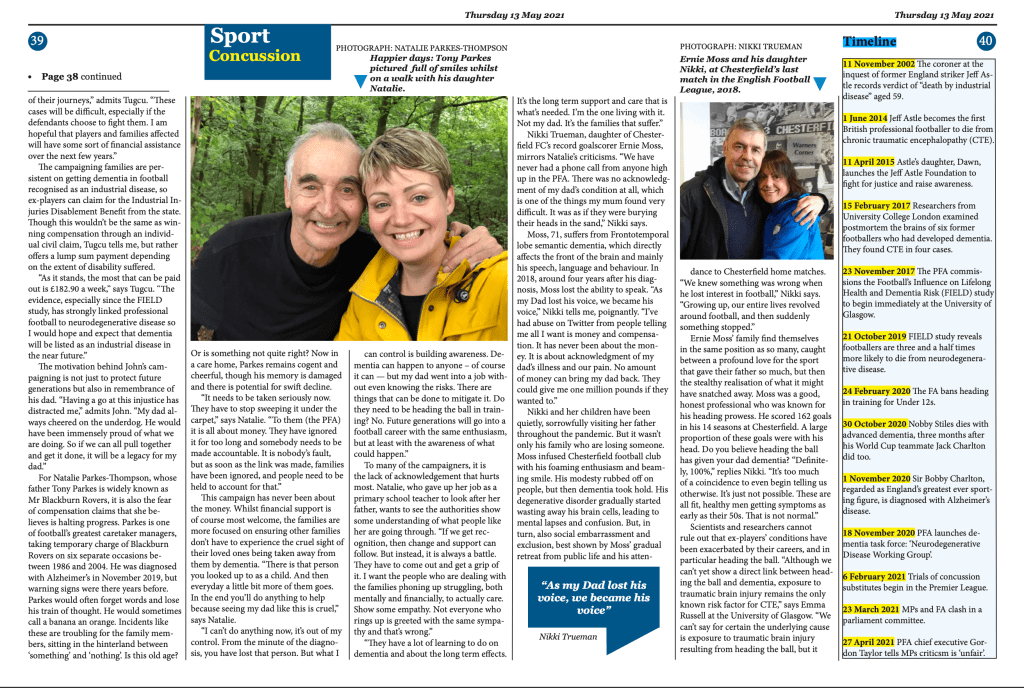
For Natalie Parkes-Thompson, whose father Tony Parkes is widely known as Mr Blackburn Rovers, it is also the fear of compensation claims that she believes is halting progress. Parkes is one of football’s greatest caretaker managers, taking temporary charge of Blackburn Rovers on six separate occasions between 1986 and 2004. He was diagnosed with Alzheimer’s in November 2019, but warning signs were there years before. Parkes would often forget words and lose his train of thought. He would sometimes call a banana an orange. Incidents like these are troubling for the family members, sitting in the hinterland between ‘something’ and ‘nothing’. Is this old age? Or is something not quite right? Now in a care home, Parkes remains cogent and cheerful, though his memory is damaged and there is potential for swift decline.
“It needs to be taken seriously now. They have to stop sweeping it under the carpet,” says Natalie. “To them (the PFA) it is all about money. They have ignored it for too long and somebody needs to be made accountable. It is nobody’s fault, but as soon as the link was made, families have been ignored, and people need to be held to account for that.”
This campaign has never been about the money. Whilst financial support is of course most welcome, the families are more focused on ensuring other families don’t have to experience the cruel sight of their loved ones being taken away from them by dementia. “There is that person you looked up to as a child. And then everyday a little bit more of them goes. In the end you’ll do anything to help because seeing my dad like this is cruel,” says Natalie.
“I can’t do anything now, it’s out of my control. From the minute of the diagnosis, you have lost that person. But what I can control is building awareness. Dementia can happen to anyone – of course it can — but my dad went into a job without even knowing the risks. There are things that can be done to mitigate it. Do they need to be heading the ball in training? No. Future generations will go into a football career with the same enthusiasm, but at least with the awareness of what could happen.”
To many of the campaigners, it is the lack of acknowledgement that hurts most. Natalie, who gave up her job as a primary school teacher to look after her father, wants to see the authorities show some understanding of what people like her are going through. “If we get recognition, then change and support can follow. But instead, it is always a battle. They have to come out and get a grip of it. I want the people who are dealing with the families phoning up struggling, both mentally and financially, to actually care. Show some empathy. Not everyone who rings up is greeted with the same sympathy and that’s wrong.”
“They have a lot of learning to do on dementia and about the long term effects. It’s the long term support and care that is what’s needed. I’m the one living with it. Not my dad. It’s the families that suffer.”
Nikki Trueman, daughter of Chesterfield FC’s record goalscorer Ernie Moss, mirrors Natalie’s criticisms. “We have never had a phone call from anyone high up in the PFA. There was no acknowledgment of my dad’s condition at all, which is one of the things my mum found very difficult. It was as if they were burying their heads in the sand,” Nikki says.
Moss, 71, suffers from Frontotemporal lobe semantic dementia, which directly affects the front of the brain and mainly his speech, language and behaviour. In 2018, around four years after his diagnosis, Moss lost the ability to speak. “As my Dad lost his voice, we became his voice,” Nikki tells me, poignantly. “I’ve had abuse on Twitter from people telling me all I want is money and compensation. It has never been about the money. It is about acknowledgment of my dad’s illness and our pain. No amount of money can bring my dad back. They could give me one million pounds if they wanted to.”
Nikki and her children have been quietly, sorrowfully visiting her father throughout the pandemic. But it wasn’t only his family who are losing someone. Moss infused Chesterfield football club with his foaming enthusiasm and beaming smile. His modesty rubbed off on people, but then dementia took hold. His degenerative disorder gradually started wasting away his brain cells, leading to mental lapses and confusion. But, in turn, also social embarrassment and exclusion, best shown by Moss’ gradual retreat from public life and his attendance to Chesterfield home matches. “We knew something was wrong when he lost interest in football,” Nikki says. “Growing up, our entire lives revolved around football, and then suddenly something stopped.”
Ernie Moss’s family find themselves in the same position as so many, caught between a profound love for the sport that gave their father so much, but then the stealthy realisation of what it might have snatched away. Moss was a good, honest professional who was known for his heading prowess. He scored 162 goals in his 14 seasons at Chesterfield. A large proportion of these goals were with his head. Do you believe heading the ball has given your dad dementia? “Definitely, 100%,” replies Nikki. “It’s too much of a coincidence to even begin telling us otherwise. It’s just not possible. These are all fit, healthy men getting symptoms as early as their 50s. That is not normal.”
Scientists and researchers cannot rule out that ex-players’ conditions have been exacerbated by their careers, and in particular heading the ball. “Although we can’t yet show a direct link between heading the ball and dementia, exposure to traumatic brain injury remains the only known risk factor for CTE,” says Emma Russell at the University of Glasgow. “We can’t say for certain the underlying cause is exposure to traumatic brain injury resulting from heading the ball, but it remains the most likely explanation.”
Studies have calculated that a football in the modern game can sometimes strike players’ heads at incredibly high speeds of up to 128km/hour. When a ball strikes the head, the brain, which is floating within the skull cavity, bounces against the skull’s back wall, leading to bruising.
John, who predicts his dad Nobby headed the ball between 70,000 and 100,000 times during his 15 year playing career, thinks banning heading in training should happen immediately. “Any reduction in heading will be beneficial, that’s a fact. You could reduce the risk by about 90% if you take heading out of training. It is as simple as that,” argues John.
Natalie is in agreement that removing heading in training is a simple next step. “Heading the ball has become such a skill and it’s in the school curriculum. That’s not right. My friend’s child, a three year old, went to a toddler football class and was taught to head the ball in the first session. Why?”
As well as the raw human stories, there are also the hard medical facts to back this up. A 2018 study by the University of British Columbia found the blood levels of specific proteins associated with damage to nerve cells increase after heading a football. It is believed heading in matches is not the issue, but instead repeated heading in training drills.
“A lot of people get dementia and nothing they could ever do would change that. It is genetic. We’ve never had it in this family. It is not genetic, it is football,” Natalie adds, confidently. But would they still go into a football career even with the risk of dementia? “My Dad would never have changed what he did. If you sat him down when he signed his first contract, and told him dementia is a risk when you retire, he would still have signed on the line. But at least he would have been aware of it.”
Reducing heading in training is an idea that brain injury charities, such as Head For Change, are campaigning for. “The single biggest thing they can do is reduce heading in training,” says Joel Voysey, co-founder of Head For Change. “It seems to us that there is quite clearly a connection between the two, even if it is not direct.”
The charities aim, above all, is to set aside the antagonism that has defined the narrative so far between players, authorities and scientists and to unite in response. “We have a convening role in bringing people together, making sure the players’ needs are central to the research debate,” Joel says. “We want to amplify the research already done by others. The evidence is there for change. The parliament inquiry is a start, but football may have to change radically to enable greater safety for the players.”
Voysey cites a parliament inquiry by the Department for Digital, Culture, Media and Sport (DCMS). It consists of a select committee with affected families, scientists, researchers and the authorities giving evidence.
On April 27, the PFA chief executive Gordon Taylor appeared before MPs, continuing to stand by his union, stating any criticism of the union’s response to the crisis was “unfair”. “We’ve never been asleep on it. We were frustrated by the initial research. The data was not there in our own national health service. And that is a factor for you to consider,” said Taylor.
In it’s written evidence, the PFA said it knew of 276 former players with a neurodegenerative disease, 132 who were still living with the condition, 144 of which have passed away. Yet the families tell me there are hundreds more. Dawn Astle, who set up the Jeff Astle Foundation in 2015, says she holds an A4 notebook with the names of over 400 former players with dementia. “Football doesn’t want to think it can be a killer,” Dawn Astle said when giving her evidence in the parliament committee. “But I know it can, because it’s on my dad’s death certificate.”
Taylor told MPs it was not just the PFA’s responsibility. “It needs more than just the PFA to be involved in this. It needs the government to realise the seriousness of dementia and how it’s affecting more people, irrespective of whether they have played football,” said Taylor.
NHS research suggests that over 850,000 people in the UK are living with dementia, with that number expected to surpass one million by 2025. “Diagnostic rates have increased dramatically over the last few years because we are better at diagnosing, people are living longer and we’re more aware of the condition itself,” says Anna Bennett, a mental health nurse at the NHS.
But what John Stiles found most alarming is the age at which former players develop symptoms, with his father Nobby deteriorating as early as his 60s. Jeff Astle died at the age of 59, after battling the disease for some time. Natalie says she was worried by her dad’s spiralling health in his mid 60s. Even in their pomp some could be struggling. They say dementia only concerns the old but research by the Alzheimer’s Society reveals that around 5% (42,000) of the total dementia diagnoses are under 65s. Dementia does not only prey on the elderley.
And so perhaps the stigma surrounding dementia, that ex-players have these brain diseases because they are part of the ageing process, has led football’s authorities to relax for too long. “It’s absolutely everywhere. Not all these people just have dementia because of their age,” says Natalie. “It’s obvious. That’s not even from anyone who is medically trained.” The curse of dementia is all around the game, in society and intensifying.
John Stiles points to how the physical well-being of his dad actually disguised his dementia condition. Footballers are athletes, after all, and such physicality doesn’t fade away overnight. “Although their brains are damaged, their bodies are strong and they’re likely to need care for a much longer time than the normal population,” John tells me. “I was told my dad would die four years before he did. His cardiovascular system was excellent.”
This is why dementia is so complex. It is irrational and unconfined in its affliction. It gives rise to such dread because no two patients suffer the same, with the three stages (mild, moderate and severe) coming at different times. The diagnosis of dementia, though, as John and his family discovered, need not be life-destroying. Nobby, John says, may not have been as bright-minded in his late years, but his humility and decency always remained. “Just a very quiet and humble man. He treated everybody the same,” John tells me with pride. Despite his heroics with England in 1966, and then Manchester United in 1968, his modesty stayed intact. “If you went into his house, you wouldn’t even know he had been a footballer. He had one picture on his wall of the 1966 squad and that was it.”
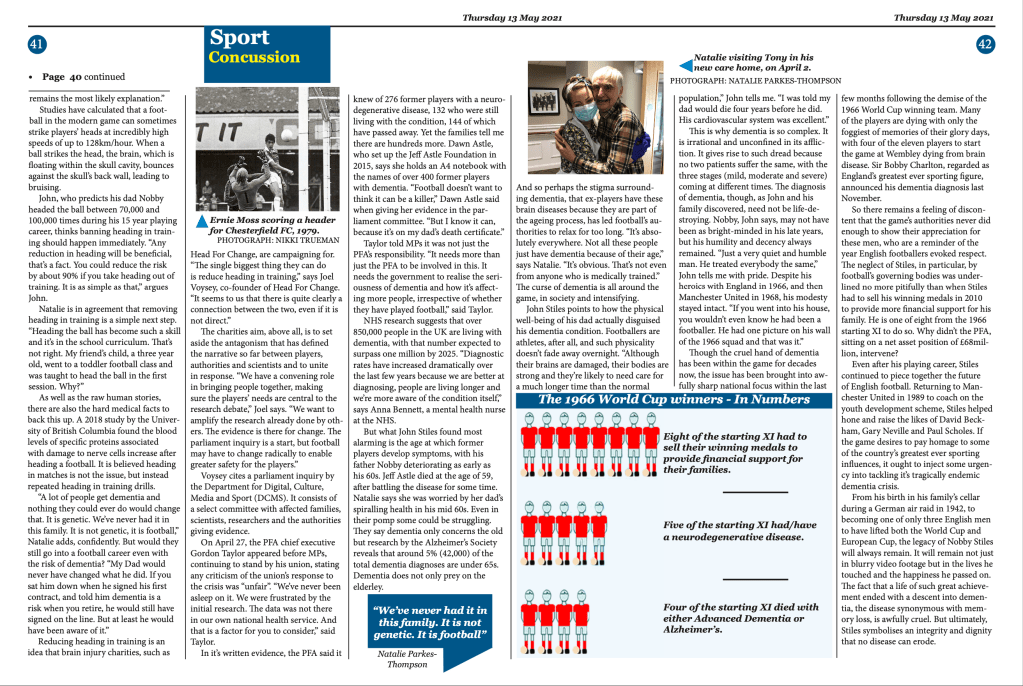
Though the cruel hand of dementia has been within the game for decades now, the issue has been brought into awfully sharp national focus within the last few months following the demise of the 1966 World Cup winning team. Many of the players are dying with only the foggiest of memories of their glory days, with four of the eleven players to start the game at Wembley dying from brain disease. Sir Bobby Charlton, regarded as England’s greatest ever sporting figure, announced his dementia diagnosis last November.
So there remains a feeling of discontent that the game’s authorities never did enough to show their appreciation for these men, who are a reminder of the year English footballers evoked respect. The neglect of Stiles, in particular, by football’s governing bodies was underlined no more pitifully than when Stiles had to sell his winning medals in 2010 to provide more financial support for his family. He is one of eight from the 1966 starting XI to do so. Why didn’t the PFA, sitting on a net asset position of £68million, intervene?
Even after his playing career, Stiles continued to piece together the future of English football. Returning to Manchester United in 1989 to coach on the youth development scheme, Stiles helped hone and raise the likes of David Beckham, Gary Neville and Paul Scholes. If the game desires to pay homage to some of the country’s greatest ever sporting influences, it ought to inject some urgency into tackling it’s tragically endemic dementia crisis.
From his birth in his family’s cellar during a German air raid in 1942, to becoming one of only three English men to have lifted both the World Cup and European Cup, the legacy of Nobby Stiles will always remain. It will remain not just in blurry video footage but in the lives he touched and the happiness he passed on. The fact that a life of such great achievement ended with a descent into dementia, the disease synonymous with memory loss, is awfully cruel. But ultimately, Stiles symbolises an integrity and dignity that no disease can erode.
 Alex's Sports Column