The Nottingham Forest academy prospect on life as an academy footballer, his journey and sacrifices, and his next steps.
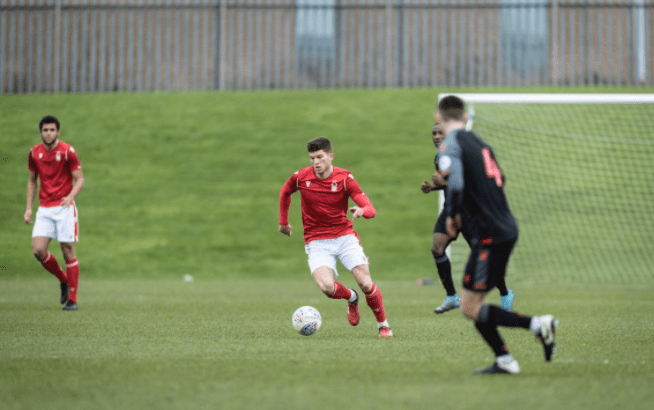
Barnes (pictured) on the ball for Nottingham Forest
Every club needs their youth prospects: the players who point the way forward, who portend better times ahead. From a young age, they are nurtured to perfection, inhabiting a world that runs on rhythms and routines, all setting them up to reach that one goal: playing for their boyhood club. Josh Barnes, 19, on Forest’s books since the age of eight, has impressed at both the foundation and youth development phase, and now finds himself embracing the pressure that is part of professional development. Despite not playing for the senior team yet, Barnes is still dreaming about the possibility of representing his beloved club.
For now, however, Barnes is staying grounded, sticking to the plan. “I’ve had a full season with the Under-23s now and they’ll be pushing me to find a loan move next season. Players tend to follow similar paths, and it’s a vital experience – just look at the likes of Cash, Worrall and Yates, they all excelled in the lower leagues,” he says. A loan move, with several League Two clubs interested, would be an ideal learning curve for Barnes: a chance to hone and develop his game in the harsh glare of the professional game.
Can Barnes grow in the same way others have? Eight of the current 25-man first team squad are Nigel Doughty Academy graduates. It’s not a process we should assume youth players can undertake on their own: footballers do not simply develop automatically, like house plants left in a sunny window. Barnes owes his development over the years not only to his ferocious work rate, but to the support and guidance of his family.
His parents have always sought opportunity, always been driven. “When I was younger my parents drove me to every away game, whether it be Newcastle or Southampton. My dream was always to play football, and it’s my parents who’ve helped me get here. Even now, my dad still travels to every game. He’s always telling me how I can improve. It’s great having him there.”
Barnes is keen to emulate his team-mate Brennan Johnson, who made his debut on the first day of the season, after quickly making inroads to the fringes of the first team. “The manager clearly has faith in the academy and seeing Brennan play is amazing. It’s such a big squad but I’m training at least twice a week with the first team now. The first time I joined in was intense, but I’m more comfortable now. The difference in quality is huge. The gaffer is always saying, just look at the others who’ve been through this process, making sacrifices to get to where they are now.”
So has Barnes. Academies can be the point at which the unfettered ambition of youth collides head-on with the severe reality of making sacrifices in your childhood and social life. Not least those delicate secondary school years, where players have to balance training and studying. “I got on with my schoolwork. It was both my parents pushing me and personal pride. I always asked myself, what if I don’t become a professional footballer? That was my motivation. You need a back-up; in case you get released or a career ending injury.”
At youth academies, strong scouting strategies are in place, using the skill of talented scouts to spot thrilling promise in players no older than six or seven, using data as well as instinct to winnow players from talent pools of thousands. Barnes was scouted playing for West Bridgford Colts, one of the largest grassroots clubs in the UK with 73 teams. “I was approached at a tournament and then invited on trials. Thankfully I only played one game and I was in the academy. You have to be tough and prove you will give it everything.”
From then on, he has never looked back. Throughout his development years he has had access to all the underlying metrics he could possibly need: tactical plans, fitness data, opposition scouting. But the video analyst cannot tell you what it would feel like for Barnes, growing up within a mile of the City Ground, to make his first team debut. The sports scientist cannot tell you how it feels to celebrate in front of the Trent End.
Since Forest were relegated from the Premier League in 1999, the club has ploughed through 24 managers, including caretakers. In fluctuating times, amid unprecedented turbulence, Nottingham Forest’s academy has been a constant: a talent pipeline and modern facilities to boast, and a club stalwart in Chris Cohen managing the Under-23s. “Why is he so good? He’s just a very technical coach, and when he speaks, you listen,” Barnes says. “It’s amazing having an ex-pro as your manager, especially because he spent so many years at this club. With Andy Reid as well, the two just bounce off each other and bring great energy to training. Hopefully it stays that way when we return to training.”
When that return is, however, remains unclear, with the possibility that a Covid-torched summer is merely the prelude to an annihilated autumn. “It’s tough because it’s hard to stay motivated. We’re used to competing, training and travelling: 25 of us, all the time. Next thing you know, you’re on your own,” Barnes says. But in the jaws of football’s worst crisis of its generation, clubs may now turn to their youth. “Hopefully the pandemic doesn’t affect my progress. I’m staying fit, training hard. When it’s all over I might get my chance, that’s when I could say it was all worth it. I’ve dedicated my whole life for that one moment.”
Perhaps, in a way, Barnes’ biggest challenge yet. To do justice to the romance he represents: the lifelong Forest fan, the decade of commitment spent working towards that one goal, to shackle the expectations on his shoulders. What will it feel like to make his professional debut for the club he has supported since he was born? Some things you just have to find out for yourself.
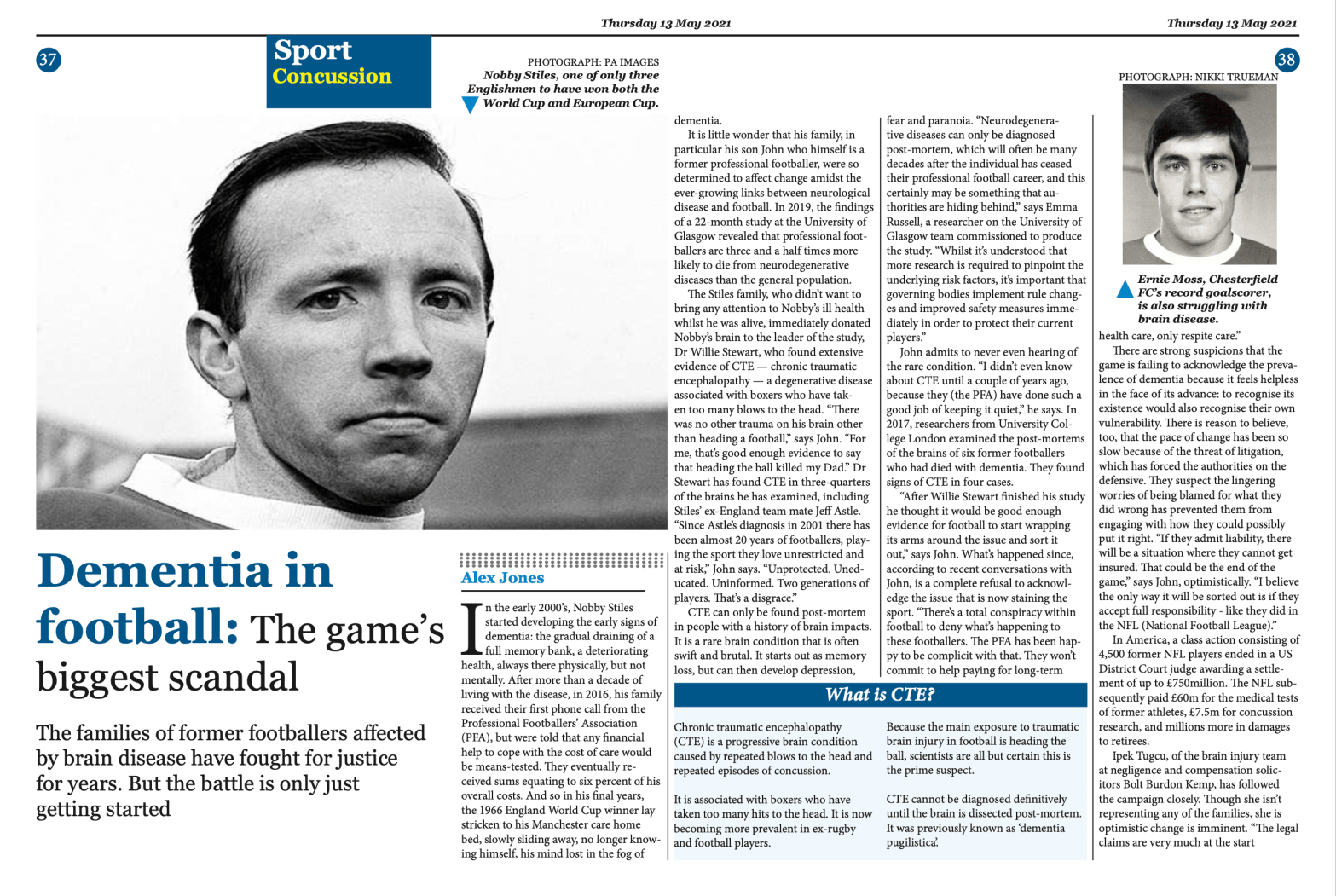
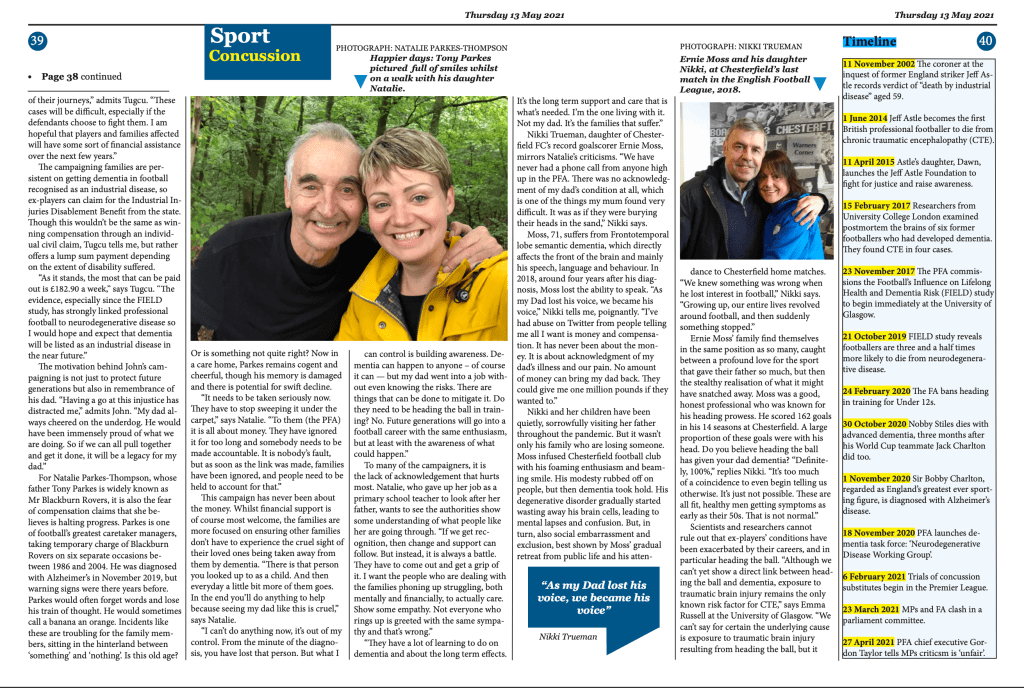
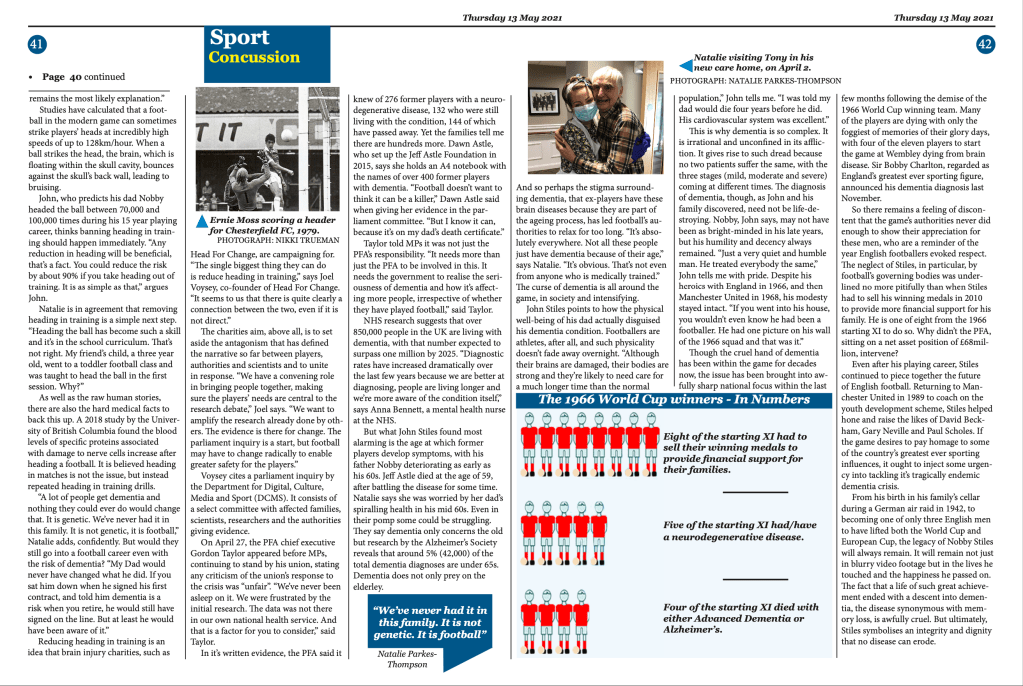
My final project at university, a 4,000 word print portfolio on Dementia in Football: The game’s biggest scandal. Below are screenshots of my Adobe PDF.
If you would like me to email a copy, please email alexjones8799@gmail.com Thanks!
In the early 2000’s, Nobby Stiles started developing the early signs of dementia: the gradual draining of a full memory bank, a deteriorating health, always there physically, but not mentally. After more than a decade of living with the disease, in 2016, his family received their first phone call from the Professional Footballers’ Association (PFA), but were told that any financial help to cope with the cost of care would be means-tested. They eventually received sums equating to six percent of his overall costs. And so in his final years, the 1966 England World Cup winner lay stricken to his Manchester care home bed, slowly sliding away, no longer knowing himself, his mind lost in the fog of dementia.
It is little wonder that his family, in particular his son John who himself is a former professional footballer, were so determined to affect change amidst the ever-growing links between neurological disease and football. In 2019, the findings of a 22-month study at the University of Glasgow revealed that professional footballers are three and a half times more likely to die from neurodegenerative diseases than the general population.
The Stiles family, who didn’t want to bring any attention to Nobby’s ill health whilst he was alive, immediately donated Nobby’s brain to the leader of the study, Dr Willie Stewart, who found extensive evidence of CTE — chronic traumatic encephalopathy — a degenerative disease associated with boxers who have taken too many blows to the head. “There was no other trauma on his brain other than heading a football,” says John. “For me, that’s good enough evidence to say that heading the ball killed my Dad.” Dr Stewart has found CTE in three-quarters of the brains he has examined, including Stiles’ ex-England team mate Jeff Astle. “Since Astle’s diagnosis in 2001 there has been almost 20 years of footballers, playing the sport they love unrestricted and at risk,” John says. “Unprotected. Uneducated. Uninformed. Two generations of players. That’s a disgrace.”
CTE can only be found post-mortem in people with a history of brain impacts. It is a rare brain condition that is often swift and brutal. It starts out as memory loss, but can then develop depression, fear and paranoia. “Neurodegenerative diseases can only be diagnosed post-mortem, which will often be many decades after the individual has ceased their professional football career, and this certainly may be something that authorities are hiding behind,” says Emma Russell, a researcher on the University of Glasgow team commissioned to produce the study. “Whilst it’s understood that more research is required to pinpoint the underlying risk factors, it’s important that governing bodies implement rule changes and improved safety measures immediately in order to protect their current players.”
John admits to never even hearing of the rare condition. “I didn’t even know about CTE until a couple of years ago, because they (the PFA) have done such a good job of keeping it quiet,” he says. In 2017, researchers from University College London examined the post-mortems of the brains of six former footballers who had died with dementia. They found signs of CTE in four cases.
“After Willie Stewart finished his study he thought it would be good enough evidence for football to start wrapping its arms around the issue and sort it out,” says John. What’s happened since, according to recent conversations with John, is a complete refusal to acknowledge the issue that is now staining the sport. “There’s a total conspiracy within football to deny what’s happening to these footballers. The PFA has been happy to be complicit with that. They won’t commit to help paying for long-term health care, only respite care.”
There are strong suspicions that the game is failing to acknowledge the prevalence of dementia because it feels helpless in the face of its advance: to recognise its existence would also recognise their own vulnerability. There is reason to believe, too, that the pace of change has been so slow because of the threat of litigation, which has forced the authorities on the defensive. They suspect the lingering worries of being blamed for what they did wrong has prevented them from engaging with how they could possibly put it right. “If they admit liability, there will be a situation where they cannot get insured. That could be the end of the game,” says John, optimistically. “I believe the only way it will be sorted out is if they accept full responsibility – like they did in the NFL (National Football League).”
In America, a class action consisting of 4,500 former NFL players ended in a US District Court judge awarding a settlement of up to £750million. The NFL subsequently paid £60m for the medical tests of former athletes, £7.5m for concussion research, and millions more in damages to retirees.
Ipek Tugcu, of the brain injury team at negligence and compensation solicitors Bolt Burdon Kemp, has followed the campaign closely. Though she isn’t representing any of the families, she is optimistic change is imminent. “The legal claims are very much at the start of their journeys,” admits Tugcu. “These cases will be difficult, especially if the defendants choose to fight them. I am hopeful that players and families affected will have some sort of financial assistance over the next few years.”
The campaigning families are persistent on getting dementia in football recognised as an industrial disease, so ex-players can claim for the Industrial Injuries Disablement Benefit from the state. Though this wouldn’t be the same as winning compensation through an individual civil claim, Tugcu tells me, but rather offers a lump sum payment depending on the extent of disability suffered.
“As it stands, the most that can be paid out is £182.90 a week,” says Tugcu. “The evidence, especially since the FIELD study, has strongly linked professional football to neurodegenerative disease so I would hope and expect that dementia will be listed as an industrial disease in the near future.”
The motivation behind John’s campaigning is not just to protect future generations but also in remembrance of his dad. “Having a go at this injustice has distracted me,” admits John. “My dad always cheered on the underdog. He would have been immensely proud of what we are doing. So if we can all pull together and get it done, it will be a legacy for my dad.”
For Natalie Parkes-Thompson, whose father Tony Parkes is widely known as Mr Blackburn Rovers, it is also the fear of compensation claims that she believes is halting progress. Parkes is one of football’s greatest caretaker managers, taking temporary charge of Blackburn Rovers on six separate occasions between 1986 and 2004. He was diagnosed with Alzheimer’s in November 2019, but warning signs were there years before. Parkes would often forget words and lose his train of thought. He would sometimes call a banana an orange. Incidents like these are troubling for the family members, sitting in the hinterland between ‘something’ and ‘nothing’. Is this old age? Or is something not quite right? Now in a care home, Parkes remains cogent and cheerful, though his memory is damaged and there is potential for swift decline.
“It needs to be taken seriously now. They have to stop sweeping it under the carpet,” says Natalie. “To them (the PFA) it is all about money. They have ignored it for too long and somebody needs to be made accountable. It is nobody’s fault, but as soon as the link was made, families have been ignored, and people need to be held to account for that.”
This campaign has never been about the money. Whilst financial support is of course most welcome, the families are more focused on ensuring other families don’t have to experience the cruel sight of their loved ones being taken away from them by dementia. “There is that person you looked up to as a child. And then everyday a little bit more of them goes. In the end you’ll do anything to help because seeing my dad like this is cruel,” says Natalie.
“I can’t do anything now, it’s out of my control. From the minute of the diagnosis, you have lost that person. But what I can control is building awareness. Dementia can happen to anyone – of course it can — but my dad went into a job without even knowing the risks. There are things that can be done to mitigate it. Do they need to be heading the ball in training? No. Future generations will go into a football career with the same enthusiasm, but at least with the awareness of what could happen.”
To many of the campaigners, it is the lack of acknowledgement that hurts most. Natalie, who gave up her job as a primary school teacher to look after her father, wants to see the authorities show some understanding of what people like her are going through. “If we get recognition, then change and support can follow. But instead, it is always a battle. They have to come out and get a grip of it. I want the people who are dealing with the families phoning up struggling, both mentally and financially, to actually care. Show some empathy. Not everyone who rings up is greeted with the same sympathy and that’s wrong.”
“They have a lot of learning to do on dementia and about the long term effects. It’s the long term support and care that is what’s needed. I’m the one living with it. Not my dad. It’s the families that suffer.”
Nikki Trueman, daughter of Chesterfield FC’s record goalscorer Ernie Moss, mirrors Natalie’s criticisms. “We have never had a phone call from anyone high up in the PFA. There was no acknowledgment of my dad’s condition at all, which is one of the things my mum found very difficult. It was as if they were burying their heads in the sand,” Nikki says.
Moss, 71, suffers from Frontotemporal lobe semantic dementia, which directly affects the front of the brain and mainly his speech, language and behaviour. In 2018, around four years after his diagnosis, Moss lost the ability to speak. “As my Dad lost his voice, we became his voice,” Nikki tells me, poignantly. “I’ve had abuse on Twitter from people telling me all I want is money and compensation. It has never been about the money. It is about acknowledgment of my dad’s illness and our pain. No amount of money can bring my dad back. They could give me one million pounds if they wanted to.”
Nikki and her children have been quietly, sorrowfully visiting her father throughout the pandemic. But it wasn’t only his family who are losing someone. Moss infused Chesterfield football club with his foaming enthusiasm and beaming smile. His modesty rubbed off on people, but then dementia took hold. His degenerative disorder gradually started wasting away his brain cells, leading to mental lapses and confusion. But, in turn, also social embarrassment and exclusion, best shown by Moss’ gradual retreat from public life and his attendance to Chesterfield home matches. “We knew something was wrong when he lost interest in football,” Nikki says. “Growing up, our entire lives revolved around football, and then suddenly something stopped.”
Ernie Moss’s family find themselves in the same position as so many, caught between a profound love for the sport that gave their father so much, but then the stealthy realisation of what it might have snatched away. Moss was a good, honest professional who was known for his heading prowess. He scored 162 goals in his 14 seasons at Chesterfield. A large proportion of these goals were with his head. Do you believe heading the ball has given your dad dementia? “Definitely, 100%,” replies Nikki. “It’s too much of a coincidence to even begin telling us otherwise. It’s just not possible. These are all fit, healthy men getting symptoms as early as their 50s. That is not normal.”
Scientists and researchers cannot rule out that ex-players’ conditions have been exacerbated by their careers, and in particular heading the ball. “Although we can’t yet show a direct link between heading the ball and dementia, exposure to traumatic brain injury remains the only known risk factor for CTE,” says Emma Russell at the University of Glasgow. “We can’t say for certain the underlying cause is exposure to traumatic brain injury resulting from heading the ball, but it remains the most likely explanation.”
Studies have calculated that a football in the modern game can sometimes strike players’ heads at incredibly high speeds of up to 128km/hour. When a ball strikes the head, the brain, which is floating within the skull cavity, bounces against the skull’s back wall, leading to bruising.
John, who predicts his dad Nobby headed the ball between 70,000 and 100,000 times during his 15 year playing career, thinks banning heading in training should happen immediately. “Any reduction in heading will be beneficial, that’s a fact. You could reduce the risk by about 90% if you take heading out of training. It is as simple as that,” argues John.
Natalie is in agreement that removing heading in training is a simple next step. “Heading the ball has become such a skill and it’s in the school curriculum. That’s not right. My friend’s child, a three year old, went to a toddler football class and was taught to head the ball in the first session. Why?”
As well as the raw human stories, there are also the hard medical facts to back this up. A 2018 study by the University of British Columbia found the blood levels of specific proteins associated with damage to nerve cells increase after heading a football. It is believed heading in matches is not the issue, but instead repeated heading in training drills.
“A lot of people get dementia and nothing they could ever do would change that. It is genetic. We’ve never had it in this family. It is not genetic, it is football,” Natalie adds, confidently. But would they still go into a football career even with the risk of dementia? “My Dad would never have changed what he did. If you sat him down when he signed his first contract, and told him dementia is a risk when you retire, he would still have signed on the line. But at least he would have been aware of it.”
Reducing heading in training is an idea that brain injury charities, such as Head For Change, are campaigning for. “The single biggest thing they can do is reduce heading in training,” says Joel Voysey, co-founder of Head For Change. “It seems to us that there is quite clearly a connection between the two, even if it is not direct.”
The charities aim, above all, is to set aside the antagonism that has defined the narrative so far between players, authorities and scientists and to unite in response. “We have a convening role in bringing people together, making sure the players’ needs are central to the research debate,” Joel says. “We want to amplify the research already done by others. The evidence is there for change. The parliament inquiry is a start, but football may have to change radically to enable greater safety for the players.”
Voysey cites a parliament inquiry by the Department for Digital, Culture, Media and Sport (DCMS). It consists of a select committee with affected families, scientists, researchers and the authorities giving evidence.
On April 27, the PFA chief executive Gordon Taylor appeared before MPs, continuing to stand by his union, stating any criticism of the union’s response to the crisis was “unfair”. “We’ve never been asleep on it. We were frustrated by the initial research. The data was not there in our own national health service. And that is a factor for you to consider,” said Taylor.
In it’s written evidence, the PFA said it knew of 276 former players with a neurodegenerative disease, 132 who were still living with the condition, 144 of which have passed away. Yet the families tell me there are hundreds more. Dawn Astle, who set up the Jeff Astle Foundation in 2015, says she holds an A4 notebook with the names of over 400 former players with dementia. “Football doesn’t want to think it can be a killer,” Dawn Astle said when giving her evidence in the parliament committee. “But I know it can, because it’s on my dad’s death certificate.”
Taylor told MPs it was not just the PFA’s responsibility. “It needs more than just the PFA to be involved in this. It needs the government to realise the seriousness of dementia and how it’s affecting more people, irrespective of whether they have played football,” said Taylor.
NHS research suggests that over 850,000 people in the UK are living with dementia, with that number expected to surpass one million by 2025. “Diagnostic rates have increased dramatically over the last few years because we are better at diagnosing, people are living longer and we’re more aware of the condition itself,” says Anna Bennett, a mental health nurse at the NHS.
But what John Stiles found most alarming is the age at which former players develop symptoms, with his father Nobby deteriorating as early as his 60s. Jeff Astle died at the age of 59, after battling the disease for some time. Natalie says she was worried by her dad’s spiralling health in his mid 60s. Even in their pomp some could be struggling. They say dementia only concerns the old but research by the Alzheimer’s Society reveals that around 5% (42,000) of the total dementia diagnoses are under 65s. Dementia does not only prey on the elderley.
And so perhaps the stigma surrounding dementia, that ex-players have these brain diseases because they are part of the ageing process, has led football’s authorities to relax for too long. “It’s absolutely everywhere. Not all these people just have dementia because of their age,” says Natalie. “It’s obvious. That’s not even from anyone who is medically trained.” The curse of dementia is all around the game, in society and intensifying.
John Stiles points to how the physical well-being of his dad actually disguised his dementia condition. Footballers are athletes, after all, and such physicality doesn’t fade away overnight. “Although their brains are damaged, their bodies are strong and they’re likely to need care for a much longer time than the normal population,” John tells me. “I was told my dad would die four years before he did. His cardiovascular system was excellent.”
This is why dementia is so complex. It is irrational and unconfined in its affliction. It gives rise to such dread because no two patients suffer the same, with the three stages (mild, moderate and severe) coming at different times. The diagnosis of dementia, though, as John and his family discovered, need not be life-destroying. Nobby, John says, may not have been as bright-minded in his late years, but his humility and decency always remained. “Just a very quiet and humble man. He treated everybody the same,” John tells me with pride. Despite his heroics with England in 1966, and then Manchester United in 1968, his modesty stayed intact. “If you went into his house, you wouldn’t even know he had been a footballer. He had one picture on his wall of the 1966 squad and that was it.”
Though the cruel hand of dementia has been within the game for decades now, the issue has been brought into awfully sharp national focus within the last few months following the demise of the 1966 World Cup winning team. Many of the players are dying with only the foggiest of memories of their glory days, with four of the eleven players to start the game at Wembley dying from brain disease. Sir Bobby Charlton, regarded as England’s greatest ever sporting figure, announced his dementia diagnosis last November.
So there remains a feeling of discontent that the game’s authorities never did enough to show their appreciation for these men, who are a reminder of the year English footballers evoked respect. The neglect of Stiles, in particular, by football’s governing bodies was underlined no more pitifully than when Stiles had to sell his winning medals in 2010 to provide more financial support for his family. He is one of eight from the 1966 starting XI to do so. Why didn’t the PFA, sitting on a net asset position of £68million, intervene?
Even after his playing career, Stiles continued to piece together the future of English football. Returning to Manchester United in 1989 to coach on the youth development scheme, Stiles helped hone and raise the likes of David Beckham, Gary Neville and Paul Scholes. If the game desires to pay homage to some of the country’s greatest ever sporting influences, it ought to inject some urgency into tackling it’s tragically endemic dementia crisis.
From his birth in his family’s cellar during a German air raid in 1942, to becoming one of only three English men to have lifted both the World Cup and European Cup, the legacy of Nobby Stiles will always remain. It will remain not just in blurry video footage but in the lives he touched and the happiness he passed on. The fact that a life of such great achievement ended with a descent into dementia, the disease synonymous with memory loss, is awfully cruel. But ultimately, Stiles symbolises an integrity and dignity that no disease can erode.
For a moment all is silence. Jofra Archer stands poised. Martin Guptill awaits delivery. Lord’s pauses with them. New Zealand need two runs from the final ball to win the 2019 Cricket World Cup. Archer approaches the crease and bowls well. Guptill hits it to mid-wicket. Jason Roy gathers the ball and launches it to his wicket keeper, Jos Butler, who stumps Guptill who is a yard adrift.
At which point the whole night fell apart. England were first-time Cricket World Cup winners. Neutrals had just witnessed one of the greatest finales the sport had ever seen. Fans spilled out into the Lord’s concourses and aisles as the England players continued to celebrate, filling the night with song.
How it got to this point is anyone’s guess. As it reached the final over England needed 15 runs to win. Trent Boult, who became New Zealand’s first ever hat-trick cricketer at a World Cup, was given the responsibility to bowl.
The first few deliveries weren’t promising for England. A bouquet of groans began to descend onto the pitch, ordinary at first and then louder. Then came the twist that no-one saw coming. Ben Stokes hit it to midwicket. Guptill threw it back to the wicketkeepers’ stumps, at which point Stokes, who was diving desperately to enter his crease, obstructed the direction of the ball with his bat.
The ball went spinning towards the pavilion and hit the boundary. What now? This is a World Cup final. Surely a match of such vast importance could not be decided over a one in a million situation. Stokes surrendered and looked irritated. Cricket etiquette usually means the batsmen stop running, so they obliged. But that didn’t stop the umpire from awarding six runs.
And so, it came to the final ball, where the Kiwi’s stumped Stokes, who needed two runs off the final ball, and the match entered the super over – the equivalent to a penalty shoot-out.
Jos Butler and Ben Stokes wandered out to bat. The festering nerves inside the ground began to seep out onto the grass. They hit 15 runs and so it was over to New Zealand. The rest is history.
The post-match fireworks were barely discernible against the blue summer evening sky. It was a cruel blow for New Zealand who on another day would never have lost. In a World Cup final, there is usually only ever one winner. But tonight, the summer sport of cricket was the real winner.
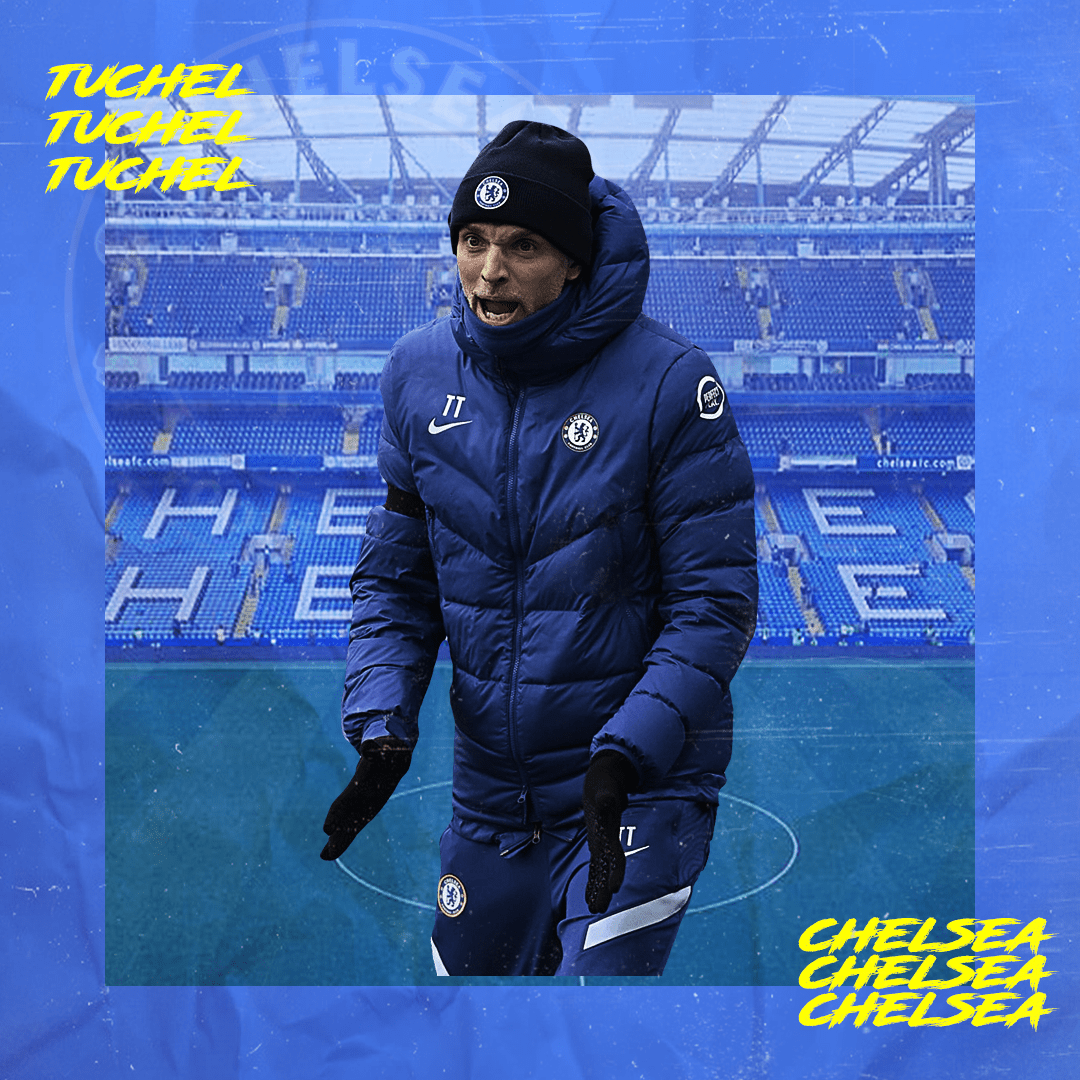
The managerial career of Thomas Tuchel is a funny old thing. His five years at Mainz saw him tasked with continuing the legacy Jurgen Klopp: the high press, the hard running, the flexibility needed in his tactics to change style when the opposition demanded it. His stint at Borussia Dortmund, where he again incorporated a club inhabiting off Klopp’s pressing philosophy, was punctuated by boardroom fallouts which ultimately lead to his demise. But this still earned him a chance at the Paris Saint-Germain job.
Though his tenure in the French capital often felt more like war than sport, a job where you constantly have to battle with a place of malaise and discord, a fanbase and culture that is never satisfied despite having all the money and trophies a French team could want. Even when winning, they never seem to be enjoying themselves.
And despite leading them to a first ever Champions League final last summer, Tuchel still ultimately ran his tenure into the ground. To succeed as a PSG coach is to find the right balance: to not only win silverware but also control the internal conflicts at the club. But Tuchel just wants to coach football and win.
So finally, enter Chelsea. Tuchel now has to prove he can get the best from Chelsea’s multimillion pound signings, not least £52m signing Timo Werner. Werner finally ended a barren run of 1,000 minutes without a Premier League goal, after finding the net against a flailing Newcastle United. Werner, and his Chelsea teammates, are finally reaping the rewards of a manager who will trust his style of play and tactics.
There was a moment just two minutes into Chelsea’s game against Newcastle on Monday night where The Blues produced a delicate little blueprint of how Tuchel is going to make them play. Timo Werner operating extremely wide on the left flank, meaning the resurgent Marcos Alonso can tuck inside and act as another attacker.
It took just two minutes for Alonso to thunderously strike a ball into Karl Darlow’s hands, a player who for all his many qualities never looks happier than when trying to leather a football as hard as he possibly can. No player on the pitch had more shots than Alonso’s five. Alonso, starved of a first team start since September before Tuchel arrived, looks eager to make up for lost time.
Credit must go to Tuchel, too, for getting better performances from Timo Werner. It appears a simple tactical shift from Frank Lampard’s favoured 4-3-3, to playing Werner as an inside left, is all that was needed. It’s the position he played well at RB Leipzig and subsequently got his move to Stamford Bridge.
This is a player who now has a coach who is already starting to get the best out of him. Tuchel is a stubborn manager who trusts his process. It seems Werner is invested. Tuchel’s task at hand with Chelsea is not only to get Chelsea back fighting for domestic trophies, but to get their money’s worth out of their star signings. Chelsea is a business, and when it feels a manager is devaluing the players the club signed, it acts quickly.
Which is what ultimately cost Frank Lampard his job. A tenure riven by discord, scarred by multiple defeats and only one win in his last five, lacking not just an identity but the most basic idea of what that identity might have been. His tactics and philosophy confused Timo Werner and Kai Havertz. His inability to utilise £72m goalkeeper Kepa Arrizabalaga upset the club’s hierarchy. Lampard could refuse to comment on his team’s lack of confidence and pinpoint it on journalists close to Chelsea. He could ridicule the idea that there was an unhappy dressing room as a distraction or media fixation. He could pretend not to pay attention to any rumours of an angry boardroom. What he couldn’t do – fatally – was unsee it.
The deciding factor in Tuchel’s success at Chelsea, then, will be to overcome the test that has ultimately sank each of his most recent predecessors: to brush aside the noise. To set reputations to one side. To block out the critics who may question tactics or philosophy. To keep players onside. And to – ultimately – create a club not one at war with itself but one in unison.
Champions aren’t flawless. It’s just you get glimpses of their flaws, but never all of them at once. They are exposed, instead, in fickle flashes and brief bolts – like shadows you think you saw in the mirror – before they are gone.
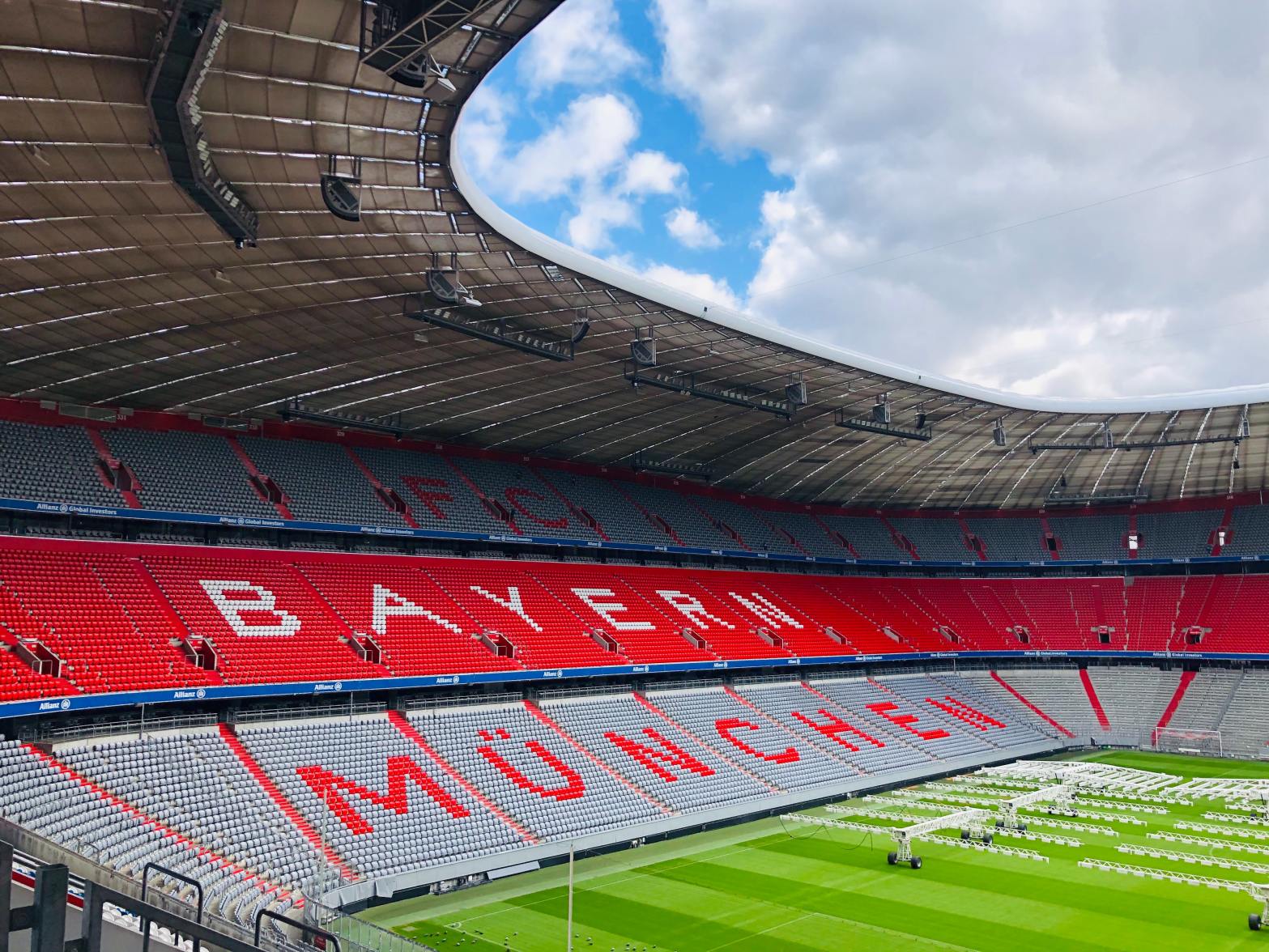
This, in many ways, is what keeps happening to Bayern Munich’s opponents: after taking an early lead, Bayer Leverkusen were eventually greeted with a relentless onslaught. If Serge Gnabry’s goal just before half-time did not settle things, then Robert Lewandowski’s 44th goal of the season probably did. As a result, Leverkusen were left mesmerised by Bayern’s physical strength and deftness of touch, chasing the game in the second half like kittens pawing at dangling threads.
But Leverkusen’s success will not be judged by defeat to Bayern. This is a team of extreme qualities: speed of pass, speed of thought, speed of movement. Their current run of form – which has seen them win 15 of their last 16 matches – has shown us that they have found more ways to win. They may not have all the right answers, but they know all the right questions.
Perhaps it may take individual quality, like Leon Goretzka’s left-footed strike in the first half. Perhaps it is as simple as one ball over the top of a flailing defence to release the striker, like Gnabry’s fine goal showed.
Or, perhaps, it is the habits that Hansi Flick has re-installed since taking over in November. One of Flick’s priorities when replacing Niko Kovac was restoring the infamous Bayern press: high energy, high tempo, high aggression. The result has been to radically alter the atmosphere at a club that on 7 December were sat in 7th place, pointing towards their worst season for 26 years.
This pressing philosophy – as much as Lewandowski’s goals or Muller’s hot streak or Neuer’s leadership, is what has seen them move seven points clear at the top of the Bundesliga.
Thomas Muller’s return to form has been somewhat interesting – a player who has never been the star of this Bayern team yet has somehow slipped under the radar: seventh in Bayern’s all-time appearance list, fourth for Bundesliga goals, top of the assists chart this season. We often point to experience or instinct to describe player’s like Muller. What we are actually describing is learned complexity, a player who has spent over a decade eluding detection, shape shifting across the pitch, filling the voids.
His success has coincided with the core of a team who have spent the best part of a decade playing together. This, as well as the spine of a team entering the peaks of their careers, is of course helpful. The fourth goal on Saturday epitomised this: Kimmich to Gnabry to Muller to Lewandowski. A short but devastating chain of attacking runs gave Muller the opportunity to place the ball on Lewandowski’s head. It was the sort of attacking play that this club demands as a bare minimum: spontaneous, clever, clinical, yet giving off the strong impression that is was rehearsed weeks beforehand on the training ground.
What of Leverkusen, then? In his press conference, Leverkusen head coach Peter Bosz accepted the difference in quality. “It looked as if we could keep up in the first 30 minutes, but even then, I felt we wouldn’t give a top performance today.” This was a telling comment, not least because it showed how opposition coaches view playing Bayern: the opposition are infinitely strong, we are infinitely weak.
Reputations stick in football. There comes a moment in any club’s run of form where their mentality and strengths are contested, their resolve challenged. The rest is for their opponents to find out. For Bayern Leverkusen on Saturday it lasted a half an hour. Borussia Dortmund, their nearest challengers, thwarted them in one half, and were merely picked apart in the other. Like green shoots pushing their way through frost-bitten earth, somehow Bayern Munich will find a way.
Perhaps like many football fans who have read the suggestions that this season may be completed behind closed doors amidst the coronavirus pandemic, I have found myself becoming increasingly irked at the authorities.
This period of sporting absence must be treated as a learning curve, not a time of sorrow. The thought of a full season resuming behind closed doors would not only be a middle finger to supporters, but it would likely confirm where the Premier League and EFL’s priorities lie. Simply ploughing through the remaining fixtures, taking a few weeks to re-charge and then going again oblivious to the current situation would be utterly irresponsible. Bringing football back prematurely primarily for the cameras, not the matchday fan, would throw all integrity down the drain.
In what is the most seismic disruption to the sporting calendar since World War II, our sporting institutions must take a backseat to reflect on current inequities of the game. Paying £39 to visit the away end at Elland Road is inexplicable. Sending Sunderland fans to Bristol on a Tuesday night is shameful. Altering kick off times and dates weeks in advance for television cameras must be executed more mindfully. This reset must be utilised for all aspects of the game, but no more so than the lifeblood of the game – the ones who keep the turnstiles clicking: the fans.
And yet to take a broader view, allowing critical paramedics and doctors to sit waiting in ambulances, as the Premier League dances on, would be reckless. To allow even one ambulance to idle its engine in the corner of a football ground instead of helping the hard-pressed NHS during a pandemic would tarnish all credibility. The only thought for now is fully empowering the NHS, not the viewing figures for Sky Sports.
As Wayne Rooney precisely put it last week – even the thought of playing on as NHS employees continue to battle on the front-line is unimaginable. The idea of the country’s elite taking to the grass whilst young children up and down the country continue to be locked down in their homes would be detrimental to the game.
So, to sit in those conference calls and come to the conclusion that a public announcement stating the season will resume on June 1st: let’s politely file that one under “optimistic moves.” These dates look to have been set based on conforming to television rights and avoid a £732 million pay-off, and not to please the fans. It would also raise questions as to the bookmaker’s influence, further questioning the already tight-knit relationship between the two.
In shifting times, amidst unprecedented circumstances, the fans have been a constant: obediently renewing their season tickets for next season [with a start date unconfirmed], tuning in to the club’s YouTube channel to re-watch classic matches from their hazily remembered past, continuing to drive money into these sporting businesses. In times like these, you truly didn’t realise what you had until its gone. Admit it, you are longing for a Super Sunday of Burnley v Newcastle and Bournemouth v Palace.
A few weeks back at Old Trafford, Watford fans flooded the urinals at full-time with hot piss and steaming rage. Thinking about what could have been, if it hadn’t had been for VAR. But in hindsight you wouldn’t change it for the world. It is the puce-tinged rage and dejection which comes with the yellow lights of hope and joy. It is not merely an outlandish point to suggest that clubs like Watford, and Villa, need their fans more than ever during fights for survival. If games were to be played without home fans, especially at times of need, then one would again have to question the priorities within the game. Why not have patience, not greed, in times like these?
One could equally argue, of course, that team’s hopeful of promotion would be disadvantaged. When Forest beat Leeds at the City Ground in early February, it was football as a crowd-event, one in which neutrals could watch the game through the prism of the fans, the shared expression of energy, watching the whole match framed through their reactions. To complete the season without the backdrop of home support would offer far too much controversy, of what could and might have been.
We now face a challenge so bizarre that no one even knows how to feel, this pandemic still seems too apocalyptic and dystopian to be true. And so, as the next few months pass by, it will be hard not to feel dejected, even a touch bereft. At the end of this hiatus we will get our merited rewards: the moments of joy when the game returns, those throbbing memories of last minute goals, and not least the feeling of relief when people are re-connected with their loved ones. Football must wait for when the NHS is ready. And when that time comes, we can all shriek our happiness and pride in unison.
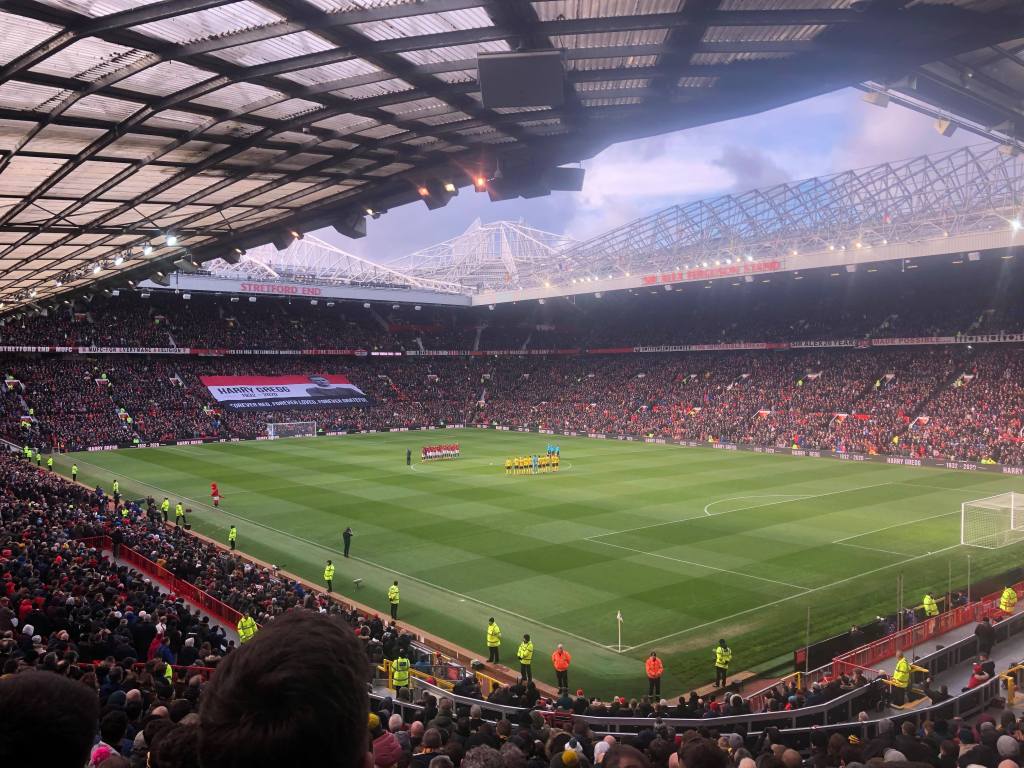
The teams pay tribute to United great Harry Gregg before kick-off.
For a moment all is silence. Bruno Fernandes stands poised. Old Trafford pauses with him. Fernandes waits. There’s two sidesteps to the left, and a leap as he feigns to shoot. Then the rippling of the net.
It takes a certain confidence in a player to take a crucial penalty in only your third Manchester United performance. Miss and you’re the pinata for all United fans’ disappointment from their first half performance. But to be fair, Fernandes never looked like a man who was about to miss.
For 40 minutes here United were underwhelming, making no clear-cut chances and it was in fact Watford who took the game to the home side, but for all their hard work and determination lacked the composure and end product to punish United’s mistakes.
The penalty that came was an excellent chance for Fernandes to give off those first impressions, dispatching a penalty with such effortlessness ease to give confirmation that the club have a new penalty taker in town. The calmness he showed was perhaps some flickering future vision of the forthcoming years, and an air of relief after recent travails from both Rashford and Martial. After all, Fernandes has scored 19 of his 21 career penalty kicks. “I wasn’t in doubt about what he would do.” Ole Gunnar Solskjaer said.
It was also the goal that set United on their way to a valuable three points, albeit with a help in hand from VAR, after Craig Dawson was adjudged to have handled the ball in the build-up to Deeney’s equaliser.
The game may have been different had VAR not intervened, nor if Deeney had punished a defensive mix-up between Harry Maguire and Nemanja Matic in the third minute. The Watford captain took one touch too many when through on goal and scuppered his opportunity. Once in front though, United were much improved.
The home side instead took their chances here and it was Fernandes at the heart of two second half goals. United’s new £60m playmaker was brought in with the prime objective of finally offering a creative spark between the midfield and attacking transitions and had great joy in doing so on the deep green of this stage, his new home.
Fernandes is a man to whom the ball itself seems mechanically attracted. After providing Anthony Martial with a lovely weighted pass for United’s second, United’s main man again found himself in space before the final goal, after Mason Greenwood shimmied his way through the midfield collisions. Fernandes gave the ball back to the 18-year-old, who finished emphatically.
It was these two second half goals that one got a glimpse of how this United midfield is going to work for a little while: Fernandes creating, Fred lurking, Matic bolting the gate. The Portuguese midfielder has immediately brought not only more skill and creativity to the United midfield, but also more belief in the players around him.
In the modern game, after all, it is your midfield which dictates the way you are going to play. The lone central pivot, Fernandes in this instance, provides a complete midfield janitorial service, constantly liaising with teammates and working with the ebbs and flows of the game, to keep all the cogs and mechanisms whirring.
In many ways, every club needs their Bruno Fernandes, their Phil Foden, their Jack Grealish who foreshadow the clubs route forward. For years, United’s midfield has long lagged behind the other top 6 clubs, but the fans’ heartfelt embrace of Bruno so far hints at a new dawn being on the horizon.
In the flesh Fernandes is simply beautiful to watch, an acutely diminutive figure who seems to flounce across the turf without leaving an imprint. A drop of the shoulders here, a flick there. You wonder what he is going to do next. And for a moment all is silence.
Six years in management. Five jobs. No wonder this Sheffield Wednesday season is quickly petering out, with their recent turmoil the embodiment of Garry Monk’s managerial career condensed into seven weeks. Promising signs, flux, a congealment of spirited mediocrity: this has been the story of Monk as a manager for years.
The Owls manager has only been in the job six months, but a perilous run of form of one win in 10 games – the latest episode an uninspiring 3-0 home defeat to Reading – has seen them drop way out of the play-off picture and looking over their shoulder.
I was there that day they notched four first half goals at the City Ground, the blue and white striped shirts swarming the red ones, a group of experienced Championship players playing with a wonderful purity about them in those moments when football just becomes a thing on rectangular green, a business of triangles, keep-ball, talent.
I was also there the other day when they made a mediocre Reading side look the real deal. Wednesday looked a team riven in angst, scarred by the thought of losing seven out of their last 10, lacking not just an identity but the most simplistic idea of what that identity might be.
There was a daunting stat doing the rounds in the press lounge pre-match on Saturday, that Wednesday hadn’t failed to score at home for four consecutive games since 2015, under Stuart Gray. There was not the slightest consensus that they were about to prevent that from repeating. And you can see why. They were so blunt in attack, the transitions from midfield to attack non-existent, offering target man Atdhe Nuhiu little to feed off.
Of course, the knee injury to top scorer Steven Fletcher has coincided with this downwards spiral, but they did have all of January to fill his void. They ended up dredging Conor Wickham out of the laundry bin in a bid to resurrect his faltering career. There were no signs, from his 25-minute stint on Saturday, that that was about to happen.
Monk praised the attitude of the fans in his post-match presser, saying “It could have been really negative, they didn’t get on the players backs at all. They backed their team.” One can never dispute the loyalty of Owls fans, not least an under-fire boss. Thousands of angry fans, instead, directed their anger at the league itself.
An animated knot of the North Stand demanded others to stand up if they hate the EFL, after it was widely reported they were close to a points deduction. Thousands of fans got to their feet. To be fair, they might simply have been heading for the exits.
A bouquet of boos rang around Hillsborough at the final whistle on Saturday, scattered and modest at first and then louder. If the boos weren’t borne out of anger at the players, like Monk repeatedly claimed in his post-match interviews, then what was really the point? Perhaps, it was the sound a fan base growing bored: bored of stagnating, going nowhere, politely taking themselves out of the play-off picture before the Spring even beckons.
Yet, for all the recent damaging performances, there is certainly reason for optimism in the underlying data that indicates Wednesday have been unfortunate: the expected goals table has them in fourth, 15 points better off. So what is this mini crisis really down to?
Monk claims that it is not down to a lack of leadership or experience, but in fact the performance levels, “we’re missing that fight for your life mentality, the extra levels of tenacity and pure will to win,” he said. Of course, work rate coincides talent. Of course, when a team isn’t at their best, they can be beaten by anyone in this league. But surely accepting the likes of Kieren Westwood and Sam Hutchinson would seriously improve this faltering team – who Monk himself seems to have pushed to the fringes of the club. Surely accepting Atdhe Nuhiu, the lone striker, is no longer up to the task, a man who instead would undoubtedly be extremely useful of shifting furniture out of a van and manoeuvring a sofa through the front-room window.
Monk pointing the finger at attitude rather than ability would have been a far easier sell if Wednesday had faced a string of games against the league’s front-runners. Instead, they have faced only one of the current top 6 and failed to beat any of the current bottom 3 in this “horrible cycle” that is the last 10 games.
Take a step back and it is an already strange managerial career for Garry Monk. 21 months, 11 months, 7 months and 15-month stints respectively. Monk has built no notable teams, created no sustained periods of success, and hasn’t had a win percentage higher than 47% at any club. He has a huge opportunity to burnish his managerial reputation and set this faltering sporting machine back on the rails. One suspects, though, he may not even be given the chance.
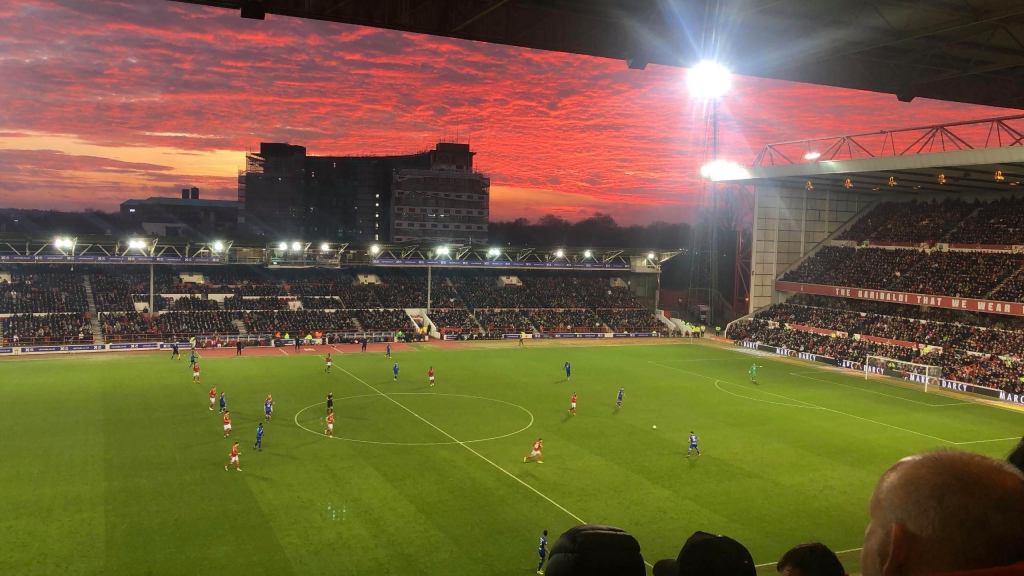
On a chilly, dank East Midlands day, where the sky drew to a close just above the lip of the Main Stand, Nottingham Forest produced a typically clinical performance as they secured a 12th win of the season to put them fourth in the Championship.
From the start there was a predictable rhythm, Blackburn were left to pass the ball, that light grey cloud pushing the red shirts back towards their goal, but with no real urgency, no surgical through balls, the porridge of sideways passing.
Forest have averaged just under 47% possession this season. They have had one shot on target versus Wigan. They won 1-0. Forest had five shots on target today. They won 3-2. You get the point. The stats make for bleak reading but while Lamouchi’s philosophy may not be the prettiest or the most entertaining, it is clearly effective.
At which point, enter Lewis Grabban. It seemed fitting that this decade must start like the last, as he scored two in this win. Grabban scored 126 goals in the last decade, who plays with the air of a man casually rearranging his sock drawer, quietly ambling around until he simply flips the switch and enters the Goal Zone.
His second here, and 14th of the campaign was exemplary of the Forest play. They had barely touched the ball before this goal. It was defence into attack in seconds, with Grabban linking up with Ameobi who gave him a beautiful cross to attack in return. Ameobi has been an astute signing, a player who spends his minutes on the pitch running about like a baby giraffe, the gangling legs, the height and speed, all excitement and fizz.
Forest are a well-grooved machine, set up from the back forwards. They are seemingly building on these better defensive displays, with the third best defence in the division, an unfamiliar tale of recent years for the Reds. For Blackburn this was a reality check, a team arriving on Trentside with only one loss in nine games but a squad not quite there yet. They showed flickering glimpses here but overall lacked the quality, with no real defensive plan, no real talent on display.
For Forest, it is a string of three wins, albeit against teams they should beat in the circumstances, and on the horizon are trips to Brentford and West Brom who sit third and second respectively. They are the real tests. They are the games that club captain Ben Watson must fire up his team, an incredibly experienced Championship holding midfielder, who again today was hidden away behind the high hedge on the last remaining patch of green.
“E-I-E-I-E-I-O, up the football league we go” the Forest fans sang, a club who haven’t tasted the top flight since 1999, and who have a long way to go to even attempt at going up. Of course, they face tough competition, but there is reason for optimism at this ghost of a sporting giant.
Sabri Lamouchi has the opportunity to burnish the clubs sacking reputation with a successful season here. No manager has managed a whole season since Billy Davies in 2009. No, really. The Frenchman has proven his tactics are working so far, with Forest sitting ready and waiting for the tides to turn, producing a fragile little blueprint of how the next decade may play out, throttle cranked, results wrung out of bloody-minded will.
Let’s hope it’s a decade of change, not least for the Forest fans, who have risen these tides of uncertainty and mediocrity more successfully than anyone else.
Pep Guardiola seemingly smiled through a barrier of pain as he answered questions on Mikel Arteta’s future on Tuesday, vowing, “I will still beat him.” In the midst of this joke was a clearly dejected Guardiola, someone losing their right-hand man, a beautiful footballing friendship finally parting ways.
But not only has the time come but also the right job has. Arteta’s audition as a top coach is over and with little to suggest he will become Guardiola’s apprentice in the coming years, this was an opportunity he couldn’t turn down. Arteta has the opportunity to begin his managerial career at a club he spent five years. He has a huge chance to build his own reputation, not known as Pep’s lieutenant, by setting this faltering machine back on the rails.
There is intrigue in this appointment, of Arteta trying to work out the shifting paradigms, the meandering paths of uncertainty. He has, in all fairness, been learning his trade and plotting his visions in management for years now, smoking and juddering on Pep’s launch pad before his own planned ascent into the clouds. There is the element of a trapped wasp under a glass about it – obvious signs of a great coach with Guardiola, Wenger and Pocchetino all routing for him to reach the very top, and he has finally been set free.
He’s undoubtedly being thrown in at the deep end. The weekly grind of the Christmas schedule awaits, with eight games in one month, the fixtures lined up like a city-centre taxi rank at midnight, lights on, engine running, ready and waiting.
18 months ago, the club decided that the best way to conceal the inevitable post-Wenger symptoms was to hire an experienced, proven and fashionable Spanish tactician. For obvious reasons this didn’t work out. And so the obvious replacement for Emery is a fashionable Spanish tactician. Just without the other bit. This is top class Premier League content.
He will have to deal with Mesut Ozil. The embodiment of the drift and decay at this ghost ship of a sporting giant. He must select his captain. None of this pulling straws business Emery opted for. Arteta must be ruthless. He will have to make the most of the Sokratis-Luiz-Chambers conundrum, until January at least, and find a way to stop conceding so many goals. They have conceded 27 goals in the league already this season. In recent weeks this team has looked unorganised and ill-disciplined, no cranial buzz, running around like a spaniel getting its first experience of the beach after a 100-mile car journey, tail wagging, turning somersaults, digging holes, paws pounding the sand.
And despite the glamour of this appointment, not too far beneath the surface there are other motives. There is debate to be had as to whether the owners are simply playing the game. Simply pleasing the customers. On 28 November The Emirates was tantalisingly close to a record-low attendance – with no way near the 49,149 tickets sold in attendance, for their match against Eintracht Frankfurt. This once regal meringue of a football club is plummeting, and the owners are reacting.
Two years after Wenger’s departure and there is still a strange electricity to The Emirates. Wenger still feels like a physical component of that gleaming glass and steel super-stadium. Inevitably the turnstiles will soon get going again, no sooner than Arteta’s first home game against Chelsea next Sunday.
Above all, though, it’s going to take more than Arteta’s tactics to wean Arsenal from these accident-laden performances. Saturday will come as a new chapter, a fresh page, and hopefully some flickering future-visions of how the Spaniards team will play.


 Alex's Sports Column